
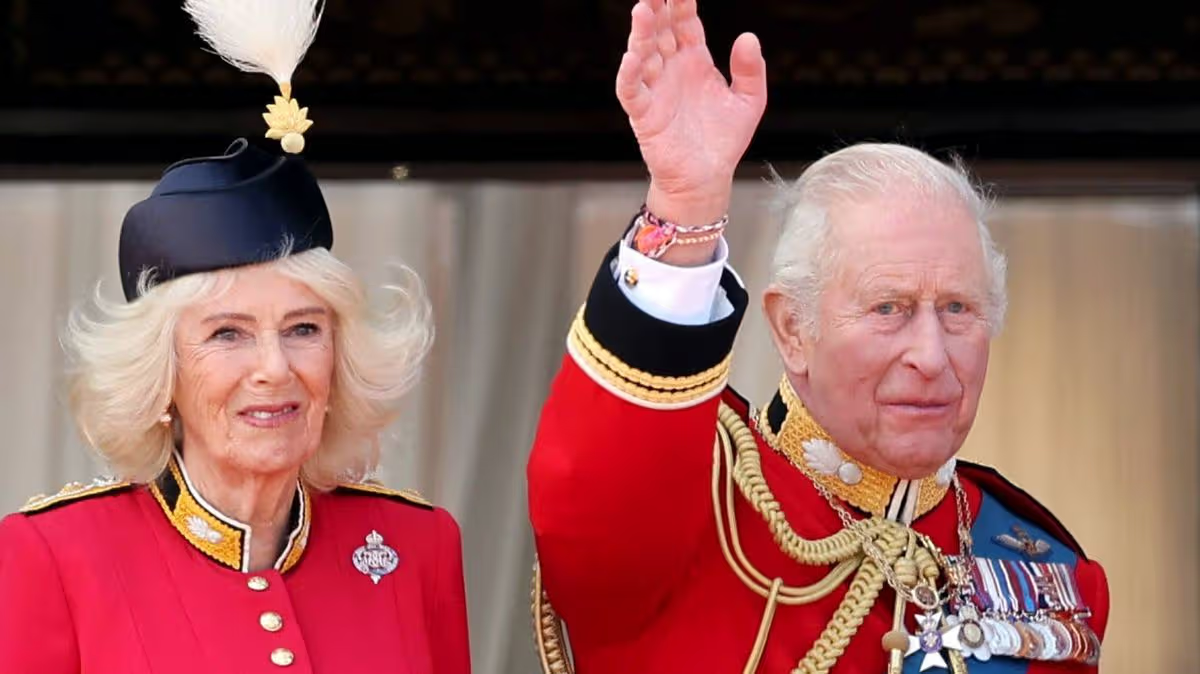
King Charles’ official London residence will remain as Clarence House, not Buckingham Palace, when a nearly £370 million renovation of the famous venue is completed next year.

The King and Queen will no longer live at Buckingham Palace after a nearly £370 million renovation is completed(Image: Getty Images)
King Charles will never live in Buckingham Palace, it has been confirmed – despite taxpayers paying £369million to refurbish the historic palace.
The iconic building will remain the operational center of “monarchy headquarters” after a decade-long renovation project ends next year, but Charles has decided it will not be the official residence of his reign. The King and Queen Camilla will continue to live at nearby Clarence House in London, while the monarch will continue to keep homes in Scotland, Gloucestershire and Norfolk, as well as use Windsor Castle in Berkshire.
Charles has lived at Clarence House, the Queen Mother’s former home, since 2003. The decision ends almost 200 years of the monarch being based at Buckingham Palace since Queen Victoria took up residence in 1837.
A 10-year reserving project to replace boilers, electrical cables and pipes at a cost of £369 million to reduce the risk of fire and flooding in London’s major buildings is due to be completed next March.
Royal aides said the world-famous historic site will continue to welcome thousands of guests each year, from world leaders on state visits to community heroes attending investiture and garden parties.
There was general expectation that Charles would live at Buckingham Palace as it was so closely associated with the late Queen, who had an apartment at her residence which would be available for Charles and Camilla to use during the day once the reservation was completed.
A spokesman for the palace argued, “Her Majesty has great affection for Buckingham Palace and deep respect for its role in royal and public life.” It will be a buzzing hive of royal activity in every way”.
Upon the publication of the annual report on the royal finances on Thursday 26 June, it was revealed how Charles would benefit from an inflation-busting pay rise – the core funding of the monarchy would increase by £100 million a year, almost doubling in the space of three years.
Under a new formula for calculating the Sovereign Grant, which pays for the royal family’s official duties and the maintenance of the royal palaces, the royal family is to receive £99.9 million as a core grant in 2027–28, £48.1 million more than the original grant of £51.8 million in 2024–25.
The change was decided by the royal trustees – outgoing Prime Minister Keir Starmer, Chancellor Rachel Reeves and James Chalmers, Keeper of the King’s Privy Purse and Treasurer.
Aides said the stimulus money would be used to pay off the maintenance backlog at occupied royal palaces, strengthen cyber security at royal residences and install energy-efficient heating systems – with £11 million set aside to replace boilers nearing the end of their lives at Windsor Castle.
Mr Chalmers stressed that the funding was “no blank cheque” and that there were strict value for money requirements. However, Norman Baker, a royal finance expert and former member of the Privy Council, said: “The royal family It is proving to be very expensive. If Charles wants to reduce his monarchy, there should be a slimmer bill for taxpayers to go along with it.”
Accounts were published for the Sovereign Grant – which is money from the Treasury that is used by the Royal Family to pay for official duties – as well as the King’s personal fortunes from the Duchy of Lancaster and the Duchy of Cornwall, which Prince William He inherited it when he became Prince of Wales.
The figures reveal for the first time that William is richer than his father, with his net worth through the duchy rising to £1.2bn. In contrast, Charles was listed in the Sunday Times Rich List with a personal wealth of £640 million – an increase of £30 million from the previous year.
The king has become the first monarch in history to disclose his private tax payments, in an effort to make the way the royal family is funded more transparent.
Charles revealed this year that he has paid more than £30million in tax since becoming king in 2022. The latest figures show he is owed £12.9 million for 2024-25 and £11.7 million for 2023-24.
The Prince of Wales will contribute £7.76m in income and capital gains tax in 2024–25 and £8.34m in 2023–24. It has also emerged that William will return the £1.5million annual rent generated by the abandoned Dartmoor prison.
He has called for the amount to be removed from the millions of pounds of income the Duchy of Cornwall receives as heir to the throne from 2026-27 onwards, with the money instead being spent on regeneration of the local community.









Leave a Reply