
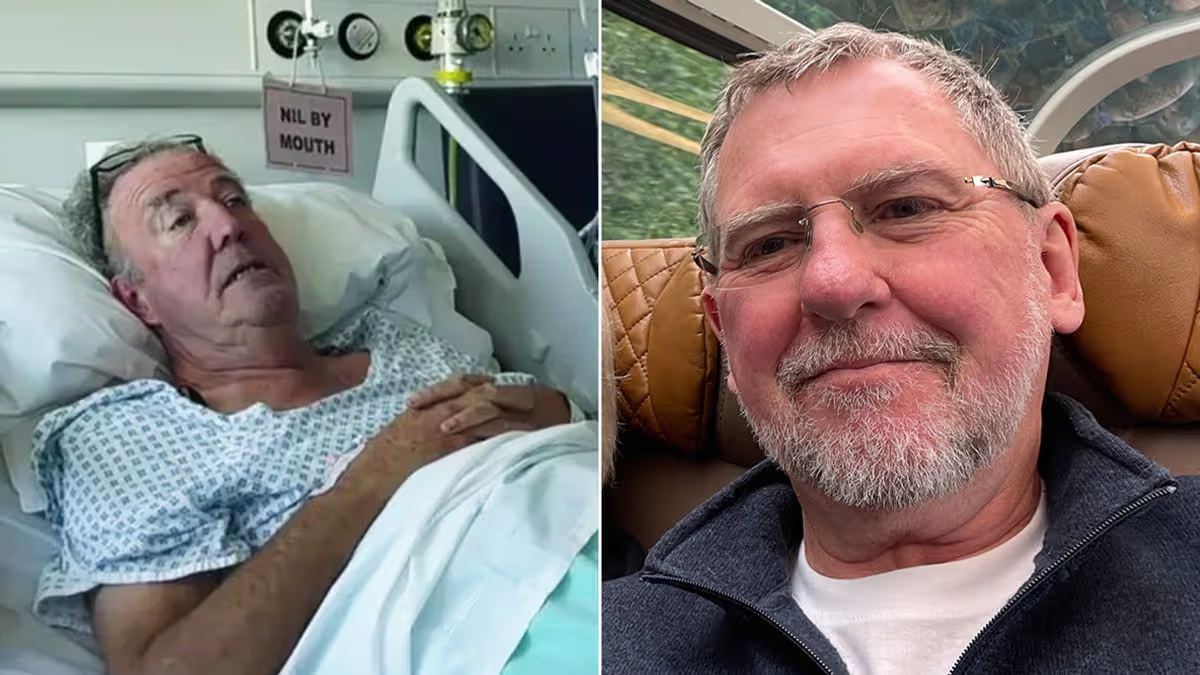
Exclusive: After Jeremy Clarkson revealed he had aggressive prostate cancer, survivor Mike Collins shares how he was diagnosed despite having no symptoms and why a hidden clue saved his life

Jeremy Clarkson reveals his diagnosis in the latest two episodes of his show
A British father has the same type of cancer jeremy clarkson has issued an important warning to men across the country.
East top Gear The presenter revealed his devastating prostate cancer diagnosis in the final episode of his hit show Clarkson’s Farm, which aired last night. His friend and farm manager, Caleb CooperHe started crying bitterly on this news.
The star confirmed that although his cancer was caught early, it was an “aggressive” form that required him to be hospitalized. For 67-year-old Mike Collins, Clarkson’s diagnosis She recalls her experience of finding out her shock diagnosis had been missed by the GP.
It is a disease that affects one in eight men in the UK and often develops silently, with up to 80 per cent of men showing no symptoms. “People hear offensive words and think the worst,” says Mike.
“This means that cancer Fast growing and more likely to spread beyond the prostate to the bones or other parts of the body. But if it’s caught before it happens, it can still be treated successfully.”
Mike, a trustee of the Prostate Project charity, believes Clarkson’s treatment options may depend on the exact nature of the disease, but could include surgery, radiotherapy, hormone therapy or a combination of treatments.
“If it’s aggressive, doctors will want to actively treat it rather than just monitor it,” he says. “This may mean surgery or a course of radiotherapy, often in conjunction with hormone treatment. If detected early the prognosis can still be very good.”
Clarkson was diagnosed last summer and had surgery to remove 10 percent of his prostate, just eight months after heart surgery for blocked coronary arteries.
Less than a year ago, Mike was diagnosed with prostate cancer, even without any symptoms. Ironically, he discovered it while volunteering at a mobile PSA testing unit and encouraging other men to get tested.
The retired Surrey resident was attending the British Motor Show in Farnborough last summer when he found himself demonstrating to a member of the public how to see the results of a PSA test NHS Application.
The PSA blood test measures levels of prostate-specific antigen, a protein produced by the prostate gland. Elevated levels may be a sign of cancer, although the test is not perfect. “I was showing this kid how to look at his results and I realized I only had two years of records,” recalls Mike.
He arranged for a blood test through his GP and, a few days later, volunteered again at CarFest, showing people how to access their results. The result that came was reassuring. His PSA level was within normal limits.
But when Collins looked more closely at the graphs showing his testing history, nothing added up. “My PSA had increased 50 percent in three years,” he says. “The actual result was still classified as normal, but the trend was not.”
A conversation with Professor Stephen Langley, a leading prostate cancer expert and colleague of the Prostate Project, changed everything. “They said that’s not true. As men age, PSA levels do increase, but not to 100 percent. That’s why further investigation was done.”
An MRI scan raised concerns, while a subsequent biopsy confirmed the diagnosis of prostate cancer, graded three out of five but still present within the prostate capsule.
Because it had not spread, Mike was able to choose between having surgery to remove the prostate or undergoing targeted radiotherapy with hormone treatment, which he chose because of its quicker recovery time frame.
But the treatment was also not without challenges. Hormone therapy, which suppresses testosterone, can often trigger symptoms similar to menopause, including hot flushes, breast enlargement and brain fog.
“I’m still on hormones,” he says. “The fog of memories was probably the biggest thing for me.” Still, when he learned he was cancer-free on May 5 this year, the result was what he had hoped for.
This diagnosis was still a complete shock to Mike, who had also lost a close friend to the disease years earlier. He and his wife attended counseling together. “We looked at each other and cried a little,” he says. “Even when you’re told it’s treatable and the consultant is optimistic, it’s still scary to hear the word cancer.”
His two sons, both in their thirties, were very worried. Having a father with prostate cancer means his risk of developing the disease is about twice the normal rate. Another risk factor is ethnicity, with one in four black men developing prostate cancer during their lifetime, compared to one in eight men overall.
Now more than ever, Mike is committed to raising awareness. He believes more men should know they have the right to request a PSA test from their GP from the age of 50, even if they have no symptoms. Men with a family history of prostate cancer and black men are often advised to consider testing starting at age 45.
“I had no symptoms,” he says. “If I hadn’t seen that graph and seen the change, I wouldn’t have known anything was wrong. That’s why men need to take responsibility for their health. Don’t wait for symptoms. By then, it may be too late.”
Mike has urged men to check their results on the NHS app, which will show a three-year graph that could be missed by a GP.













Leave a Reply