
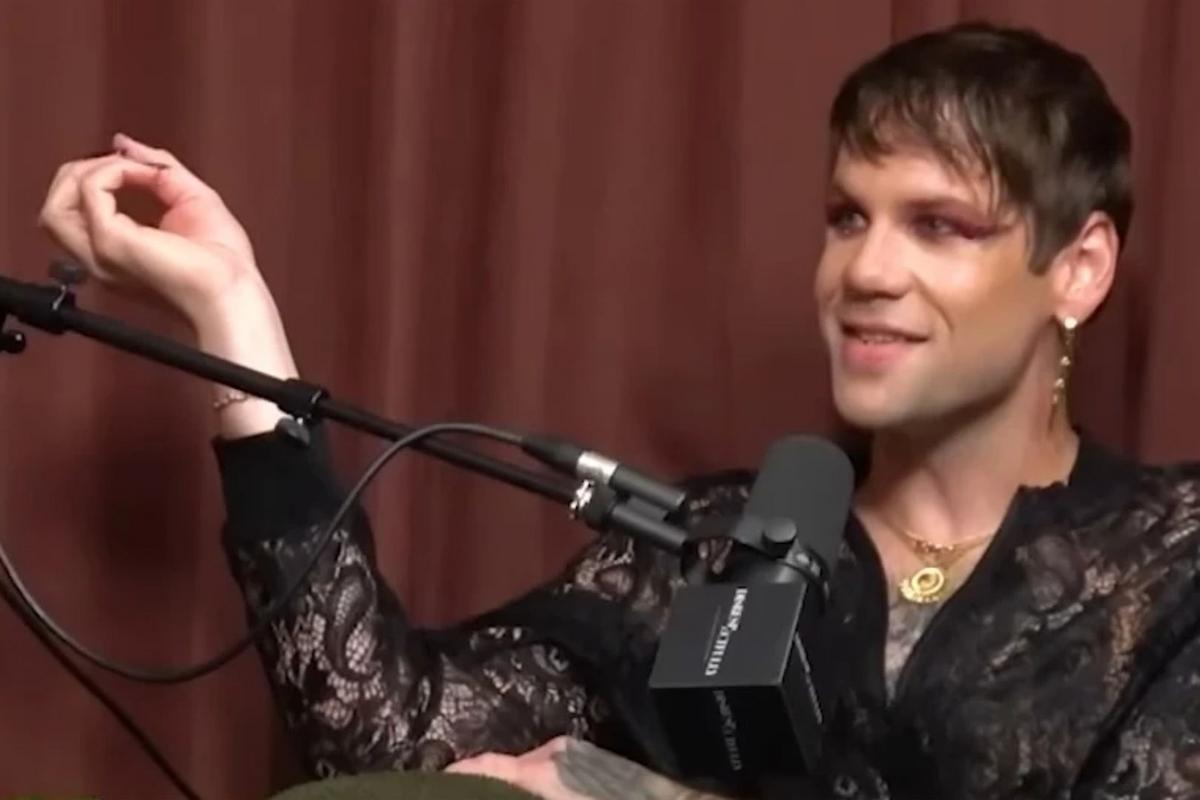
Bear tooth frontman Caleb Shomo now talks about his religious upbringing, the inherited perceptions of being gay that came with it, and the barriers it caused on his path to released last month.
The singer was a guest on Disrespectful podcast with hosts Katie Maloney and Dayna Kathan where he took a deep dive into his identity struggle from early childhood to the present day.
Throughout the podcast, Shomo unpacked his religious upbringing and how being gay was considered a “disease” while growing up. He also touched on peer pressure he faced as a child and revealed his true self on Beartooth’s upcoming album Pure ecstasy and coping mechanisms he turned to as he struggled to know and understand his sexuality.
Caleb Shomo discusses his religious upbringing
In the chat, the Beartooth frontman talked about being raised in a deeply religious family as “the son of a preacher who is the son of a preacher” and his mother, a nurse, who came from a religious family. His parents fell in love while attending a Christian college, and Shomo made it clear up front that he loves his parents and felt they were doing the best they could, but that the teachings of Christianity conflicted with what he was going through and instilled some negative perceptions of being gay as a result.
“Basically, with Christianity, you dedicate your life to Jesus, and then in the more southern side of Christianity where I come from, it’s more about serving people. And for me, yeah, I have no self-esteem, no self-love, no reason to be here other than to serve other people and love other people and follow the book. So it’s a hard place to start, and especially being gay,” he shared.
The singer says he was taught to think of being gay as “a disease that you can heal with prayer,” adding, “And then probably even more damaging than that upbringing was getting involved in a music scene in the really wild Christian era of the mid-late 2000s that I came up in, next to, say, Underneath and stuff like that, at the time it was very Christian and very evangelical and intense, and I was involved in this music scene where I was 14 when I came into the scene and hanging out with a lot of older people who are very evangelical Christians, and I was a Christian myself.”
READ MORE: 10 Rock and Metal Bands That Started Out Christian But No Longer Are
Within the discussion, he recalled an incident when he was just 16 when he joined a group of people who “tried to ask the gay out of one of our crew members.” “I’m just there going, ‘Okay, that’s it. That’s true.’ And it was so damn traumatizing. It was terrifying,” he recalled.
The singer also remembers being brought up in such a way that he never really had any platonic relationship with women. His religious upbringing dictated no sex before marriage or you will go to hell.
“People court each other very young without much understanding of themselves, and you just follow the model. And I’ve never really had any relationships with women, at all. So it was also very confusing. I did my best and just tried to follow the path, and yeah, there’s just so much I didn’t understand about myself,” the singer said.
Caleb Shomo on peer pressure + embracing his feminine side
On Disrespectful podcast, Shomo also looked back toward a specific memory where peer pressure collided with his own personal choice of expression.
“My first core memory of what I recognize is when I was probably six or seven and my mom and my older brother … we were in some department store and there were these cheap rings and we thought they were really cool. And my mom was like, ‘Okay, you can have one.’ And he picked out a guy’s ring and I picked out a girl’s ring. And he’s like, ‘You know, it’s a girl’s ring.’ And I thought, ‘Oh, I don’t know. I just love it,’ the singer recalled.
“It was half silver, half gold and it had a diamond in the middle. I loved it and I loved the way it made me feel. And I wore it all day and then I remember the next day on the bus just being made fun of by the kids… I just freaked out and didn’t really know what was going on and f—ing threw it out the window.” It was like, ‘Fuck, don’t do it. Whatever it is, let’s keep it away,” he concluded.
“For me, what it was was this very strong feminine side that I have, but it’s just not the vibe of Ohio in the Christian world. And then you grow up, the older you get, and then you hang out with a lot of older people and just have conversations that constantly remind you of how freaking weird it is to be gay or to do anything remotely gay or feminine, so that feeling that I just had and that I understood my sexual position. Divided as just self-hatred It’s this thing that’s evil in me, and okay, you fight it with all your might, and that’s the right thing to ask for.
How did Caleb Shomo manage to fight his sexuality?
Within the discussion, the singer painfully unpacked the way he tried to suppress his sexuality. He described detailed suicidal thoughts as a way to push back the idea whenever he would have thoughts that made him question his sexual identity and revealed a growing dependence on alcohol as a coping mechanism in his 20s.
If you or someone you know is having suicidal thoughts, visit National Suicide Prevention Lifeline website. Resource information is provided free of charge as well as a chat messaging service. To speak directly with a professional, call 1-800-273-8255. You are not alone and there is help available. Every life is important.
Help for drug and/or alcohol addiction is available via Substance Abuse and Mental Health Administration website. To speak with someone on the phone, call 1-800-622-HELP (1-800-622-4357) or text 1-800-487-4889.
Now Shomo is looking forward to the release of Beartooth’s Pure ecstasyan album where he finds his current self. And to get there, he was encouraged by producer Jordan Fish, who encouraged him to open up in the lyrics instead of hiding behind vague expressions.
Listen to the full episode of Disrespectful podcast below.
Beartooth’s Caleb Shomo guests Disrespectful With Katie Maloney + Dayna Kathan
What Caleb Shomo previously said about coming out as a gay man
Back in late May, Shomo came out publicly as a gay man. The singer spoke about the case in a statement.
“I’m a proud gay man,” he declared. “This is something I’ve been unpacking and figuring out in my life for a while now. It’s been difficult to navigate the emotions around the subject and figure out what to do with this fact.
“When it comes to my art / Beartooth, I’ve always strived to chase who I am in the deepest part of my soul from album to album. As you could tell if you’ve followed the band at all in the previous years, there are 4 very self-deprecating albums about exploring my religious upbringing, depression, self-hate, self-hate, self-hatred and hopelessness in the face of all these albums, and hopelessness in the face of all these albums. at times embarrassed that I wouldn’t allow myself even digging up the roots for so long.”
Shome said that coming out was “a direct path to me coming to terms with my sexuality in the hope that it will eventually lead to me experiencing self-love” and “I’m finally trying to be proud of who I am, and I think this is a massive part of that journey.”
READ MORE: Caleb Shomo’s wife comments on his sexuality and their relationship
“To those who have shown me love, empowerment through living life freely and openly in my presence, supporting the queer community, or simply telling me you love me whoever I am, I am forever in your debt and I hope you know what you mean to me,” he concluded. “I encourage anyone struggling with who they are to give yourself grace. Give yourself patience. Be honest with yourself. Do the hard work instead of burying it as deep as you physically can and believing it will change like I did. Keeping these things inside only hurt you and those around you. Love you all and hopefully this is a step in the right direction to loving myself one day.”
Below, take a look at some of the LGBTQIA+ icons of rock and metal.
32 LGBTQIA+ Icons in Rock + Metal
See photos of some of the most iconic rock and metal musicians to come out as part of the LGBTQIA+ community over the years.
Gallery credit: Lauryn Schaffner









Leave a Reply